Categories
Review

“Atomic Awakening”

James Mahaffey

Thinking about the arc of this book, it’s honestly hilarious. The introduction feels condescending; the point of it is to tell you, the reader, that you know less about nuclear science and the nuclear industry than the author. Which is true; he has a degree and a job history in nuclear engineering, he does know more about it than I do! That’s why I’m reading a book he wrote about it, instead of the other way around!

From there, it dives into the history of nuclear physics as a science. Lots of whacky 1800s anecdotes here, and an approach to lab safety that was… concerning at best.

Next, we get to the bit everyone knows at least a little about: World War II and the Manhattan Project. As much of a nerd about nuclear history as I am, there was still plenty in here that was new for me; I enjoyed the bit that General Groves, anxious about the delayed-by-a-few-hours first atom bomb test, called up the governor and threatened to impose martial law over all of New Mexico. I guess the stress ball hadn’t been invented yet.

The second-to-last portion is basically a list of every major nuclear accident. There were a few I hadn’t heard of. Windscale was a relatively recent discovery for me, but I like that every telling of it has to hit the note of Cockroft’s Folly. When the world gives you dramatic irony, you’ve gotta use it. New to me, and very interesting by appearing to be the first use of a nuclear reactor as the weapon in a murder-suicide, was SL-1.1 I do so enjoy that, in this area of interest of mine, I can still find entirely new pieces of the history to learn about.

Then, having spent something like half the length of the book describing in detail everything that can go wrong with nuclear power, the book pivots to talking about how great nuclear power is and why we should be doing more of it. Admittedly, I agree with most of the arguments; it is a very safe, low-carbon producer of energy, and having that kind of baseload available really does help with the intermittency issues posed by renewables. I’m less convinced of his assertions about nuclear waste reprocessing and storage; yes, those would be good to do, but unfortunately, we can’t make this book required reading for the entire country, so the political issues remain.

Overall, a very enjoyable read; if you, like me, never get bored of talking about nuclear energy, check it out!2

  1. Very dark comedy to the Army trying to make a Fool-Proof Nuclear Reactor; nothing says “we’ve underestimated the ingenuity of fools” like an investigation requiring tests like “now, act like you’re halfway through manually removing the control rod from the reactor, and Frank here is gonna punch you in the crotch, we need to know if the reflex response is to pull the rod further out or to drop it back in.”
    I won’t leave you in suspense: it was to drop the rod, and they concluded that it was a deliberate choice to pull it all the way out and cause the explosion. I suppose that if you’re trying to really test your ‘fool-proof’ designation, it is valuable to put some high-level fools in it and see what happens…
  2. This is a Bookshop affiliate link – if you buy it from here, I get a little bit of commission. It won’t hurt my feelings if you buy it elsewhere; honestly, I’d rather you check it out from your local library, or go to a local book store. I use Bookshop affiliate links instead of Amazon because they distribute a significant chunk of their profits to small, local book stores.
Categories
Review

“Killed by a Traffic Engineer”

Wes Marshall

If we need to constantly remind people in the transportation system to be safe, is it really a safe transportation system?

As someone who works in a field other than traffic engineering, I’m not quite the target audience of this book. There’s a lot of citations that I didn’t bother looking at, and detailed discussions of the various 1,000–page guidebooks that, presumably, every traffic engineer owns and nobody else has ever heard of. But I still found it a very interesting read; it’s basically a takedown of the current state of the field.

It’s 88 chapters long, and the majority of them are devoted to taking a “standard practice” and showing how thin the evidence backing it is. It’s more than a little disturbing to know how much of our road design is based on a single study from 60 years ago with a limited dataset and nary an attempt at replication… and which only sorta addresses the topic that became the standard. And those are the better cases! As a “fun” example, consider those retroreflective road stripes: on rural highways, it sure seems like having stripes marking the outside of the roadway, and not just the division between travel lanes, would make the road more visible and thus safer, right? Bad news, that vibes-based approach isn’t even what it’s based on; safety studies showed adding them actually increased the crash rate.

There’s a lot of that sort of thing in this book. I think my only edit I’d make is adding an 89th chapter at the end; the last three chapters are the “call to action” portion, but said calls to action are directed almost entirely at traffic engineers. Maybe throw in another one for people like me, who don’t work in the field but want to help improve things; I could use a few tips on what sorts of public comment meetings I should be attending, and what questions I should ask.

Overall, an interesting read; check it out.1

  1. This is a Bookshop affiliate link – if you buy it from here, I get a little bit of commission. It won’t hurt my feelings if you buy it elsewhere; honestly, I’d rather you check it out from your local library, or go to a local book store. I use Bookshop affiliate links instead of Amazon because they distribute a significant chunk of their profits to small, local book stores.
Categories
Review

“How to Invent Everything”

Ryan North

It’s a popular science book! We’ve got some overviews of lots of technologies, presented from a very fun conceit—this is the repair manual for a time machine, which opens with “step 1: accept that the time machine cannot be repaired. step 2: rebuild civilization from scratch.” The tone throughout is educational, though written by an under-paid employee of the time machine rental company, with just enough “for which Chronotix cannot be held legally liable”s thrown in to really hit that “this is a corporate material” vibe.

And here’s the thing: it works super well. It’s answering an exact thought I have had many times: if I had a time machine, exactly how well would I do at surviving and then improving the past? The answer was, of course, “not great.” After reading the book, I’d say it has improved somewhat… but really, I’d want to keep the book with me. Preferably a few copies. Laminated. Maybe a set of the printing plates, too, since they’re tougher than paper. Belt and braces, over here.

So, all in all, I absolutely loved this book. It set out to do a specific thing, and did it incredibly well. Check it out.1

  1. This is a Bookshop affiliate link – if you buy it from here, I get a little bit of commission. It won’t hurt my feelings if you buy it elsewhere; honestly, I’d rather you check it out from your local library, or go to a local book store. I use Bookshop affiliate links instead of Amazon because they distribute a significant chunk of their profits to small, local book stores.
Categories
Review

“How To”

Randall Munroe

This book is an exercise in decontextualization. It’s what happens if you take a Roko’s Basilisk style AI and ask it questions; you get things that are technically correct answers, but have left out all the context of, broadly, “being a human.” And, as always with Munroe, it’s hilarious.

For a general idea of what the book is like, one of the early chapters is “how to throw a pool party,” and consists almost entirely of instructions on how to build a pool. Said instructions include notes about how thick you would have to make the walls of an above-ground pool so that the water doesn’t burst out—if you were using Gruyere as the wall-building material. As it explains how the best bet for rapidly filling a pool, ignoring all costs, is to order tens of thousands of plastic water bottles and an industrial shredder—conveniently, the industrial-grade ones include the ability to separate out plastic shreds from liquids, which is probably quite useful to recycling facilities, and in the case of filling a pool means you should install it backwards—there’s an aside about the fact that using an atomic bomb is not an effective way to open water bottles.1

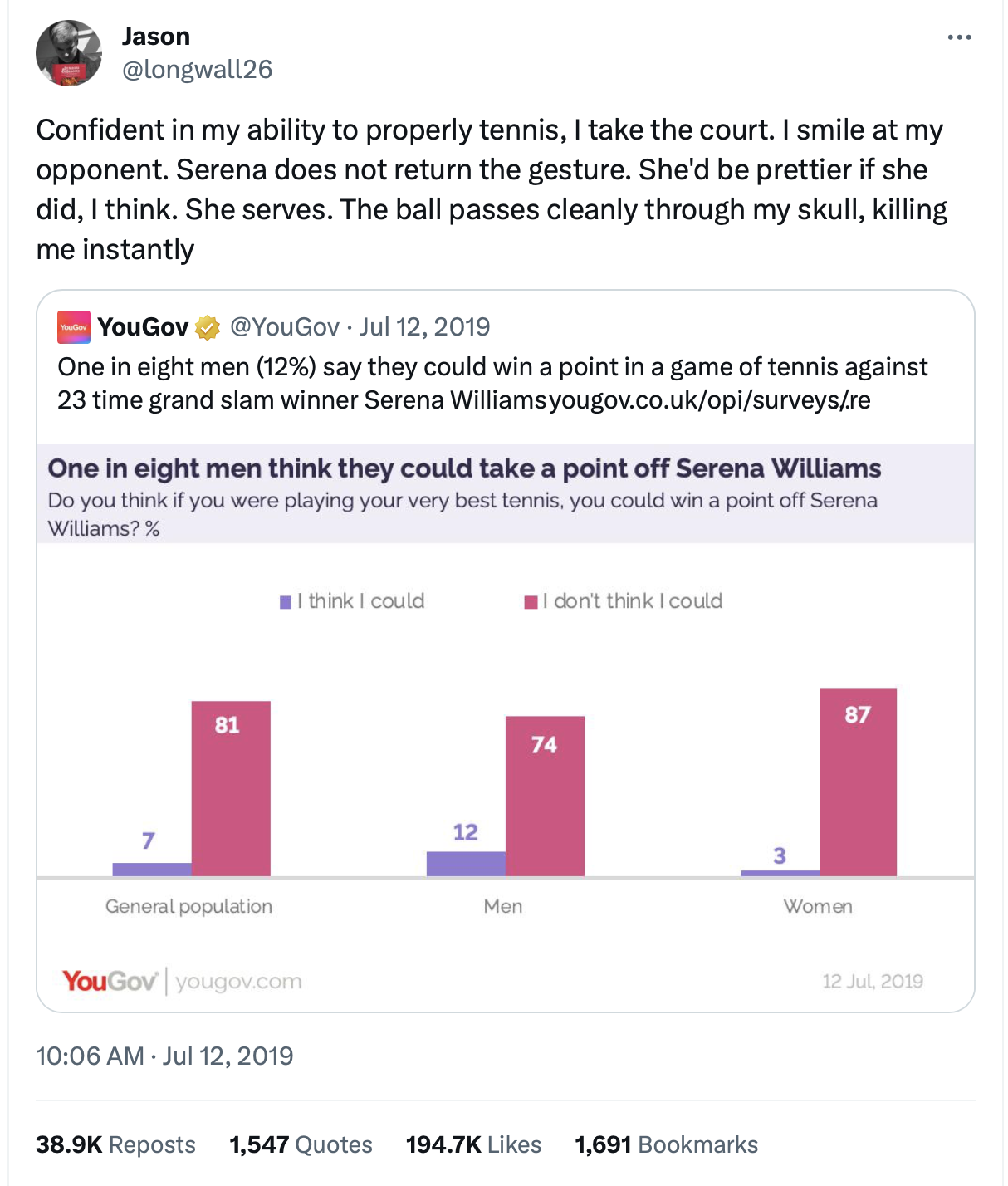
There’s also some neat guest appearances; Chris Hadfield answers a great many questions about… let’s call it flying a plane, as that’s the inspiration for most of the questions. Serena Williams makes an appearance, demonstrating that in the event of the drone apocalypse, she doesn’t need to worry.2

As with all of his books, “How To” is a delight to read, and I highly recommend it. Check it out.3

  1. One of my favorite jokes used in the book is the repeated instances of “this is a ridiculous question, and so of course the United States military studied it during the Cold War.”
  2. I spent the entire chapter with this tweet stuck in my head: Screenshot of a quote tweet. The original tweet, from YouGov, reads “One in eight men (12%) say they could win a point in a game of tennis against 23 time grand slam winner Serena Williams”. The quote tweet, from Jason, reads “Confident in my ability to properly tennis, I take the court. I smile at my opponent. Serena does not return the gesture. She'd be prettier if she did, I think. She serves. The ball passes cleanly through my skull, killing me instantly”
  3. This is a Bookshop affiliate link – if you buy it from here, I get a little bit of commission. It won’t hurt my feelings if you buy it elsewhere; honestly, I’d rather you check it out from your local library, or go to a local book store. I use Bookshop affiliate links instead of Amazon because they distribute a significant chunk of their profits to small, local book stores.
Categories
Review

“What If? 2”

Randall Munroe

One of the tropes of the internet that I really enjoy is the concept of “relevant xkcd”. As it turns out, when you spend nearly two decades publishing three comics a week, you wind up covering a staggering variety of topics, to the point that pretty much any topic will have a relevant xkcd to link to. And, in thinking about that, I’m amazed all over again at Randall Munroe’s work; there is so much xkcd. Thousands of comics… and they aren’t always stick figure things, a few times a year it’ll some sort of complex piece of software, or a gigantic world to explore, or some other exploration of what a “webcomic” really is in light of the technology of the web.

Anyhow, that’s all a digression, because in the spare time he’s apparently got from all of the above, he’s also had time to write a couple books, and all the ones I’ve read are delightful. A couple years later, I’m back to report on the sequel of the last one I reviewed, and it’s… exactly what the title implies. More “absurd hypothetical questions,” answered with a great deal of research. “Can a person eat a whole cloud?” Well, that depends — are you squeezing the air out first? If so, you can! If not, definitely no, and you may actually wind up dehydrated amidst a larger cloud than you started with.

It’s all things like that, and it really shows that Munroe is, in his way, a very effective science communicator. This feels like a great book to give to a curious kid to encourage that curiosity, and get them to ask some really interesting questions in class.1 It’s a delight, and, in the truest sense, fun for all ages. I absolutely loved this book; give it a read.2

  1. And, based on the notes in some of the questions submitted, a great many of those will quickly be directed back to Munroe, for a continuation of the series.
  2. This is a Bookshop affiliate link – if you buy it from here, I get a little bit of commission. It won’t hurt my feelings if you buy it elsewhere; honestly, I’d rather you check it out from your local library, or go to a local book store. I use Bookshop affiliate links instead of Amazon because they distribute a significant chunk of their profits to small, local book stores.
Categories
Review

“Physics of the Impossible”

Michio Kaku

I feel like I’ve been reading a lot of these “explain the whole field in broad strokes” books lately. I do enjoy the twist in this of focusing specifically on impossible things, particularly science fiction tropes; it provides a bit more of a narrative through line, a nice organizational structure to hang the various facts on.

Two caveats to this book:

Firstly, it’s somewhat dated; just from reading, you can narrow down the publishing date to sometime in the mid-aughts. The downside to writing about something as inherently contemporary as “the latest scientific discoveries.”

Secondly, the use of the definite article when referring to theories. It’s never “quantum theory”, always “the quantum theory.” Which I’ve listed as a caveat, but really it falls somewhere between being overly tied to semantics and doing a good job of reminding us that all theories are theories—sure, the theory of gravity is pretty well understood, but it remains a part of the scientific process; it remains a theory.

All told, I found this a pretty good read. The chapters are about the right size for chunks of reading time, and it’s a nice overview of the various impossibilities. (It also feels like it’d be a great reference book for a science fiction writer—it provides enough terminology and understanding to get the realistically-wrong physics you want for good sci-fi.) Give it a go.1

  1. This is a Bookshop affiliate link – if you buy it from here, I get a little bit of commission. It won’t hurt my feelings if you buy it elsewhere; honestly, I’d rather you check it out from your local library, or go to a local book store. I use Bookshop affiliate links instead of Amazon because they distribute a significant chunk of their profits to small, local book stores.
Categories
Review

“Grunt”

Mary Roach
I spent the entire time reading this book thinking that it was by the same person who wrote Combat-Ready Kitchen. Which was an interesting comparison to have in mind, as I quite liked that one, but “Grunt” was much more fun. While “Combat-Ready Kitchen” felt like it was trying to be ready for use as a textbook in a history class, “Grunt” was unabashedly written by a human being who likes to mention their human responses. I’ve got a great deal of highlights of comedic moments that Roach captured very well.1
As someone with precisely zero interest in joining the military, I think Roach is an excellent writer for this topic. Clearly she’s got a bit more experience in this area than I do — nobody who’s spent a week on a nuclear submarine doing research for a book can really be as clueless as she tries to convey — but she’s removed enough from it that she can be an excellent go-between. The feigned cluelessness doesn’t read as an affectation, it reads as making sure the genuinely clueless folks like me can follow along.
And it’s just an interesting subject matter. The Department of Defense has a spectacular research budget, which they put into doing all sorts of neat things. Nothing in the book focuses on the science of Exciting New Ways To Make People Dead; in fact, it’s almost universally focused on the opposite. I’m okay with my tax dollars going to research on reconstructive surgery and heat-stroke prevention.
I can definitely recommend “Grunt”. It’s a fun read, and the science is neat. Check it out.


  1. And a pent-up rant about just how bad the experience of trying to highlight stuff is in Apple Books. While the location of the highlight has a clear correlation to where your finger is on-screen, they’re not directly related in the way that we’re trained to expect from iOS. And god forbid you want to highlight something that spans across a page break – to date, the only way I’ve found to do this is to change the text size until they’re on the same page. Even Amazon does better than that, and their Kindle app has never not felt like an abandoned project.