Categories
Articles Education

The Reforms of Maria Theresia and Joseph II: The Enlightenment in Austria

This is an essay I wrote for a class I took in the fall of 2016, titled “Austrian Cultural History.” I’ve decided to publish it here because… why not?
The Enlightenment took longer to arrive in the Holy Roman Empire than it did for the other superpowers of the time, but arrive it did. Thanks to the lack of a strong bourgeois class within the population of the Empire, however, Enlightenment did not spring up from below as it did in France. Instead, it was applied from the top down, by the reigning monarchs of the House of Habsburg-Lorraine: Maria Theresia and, later, Joseph II. Under those two rulers (arguably three, because Leopold II, the Emperor following Joseph II, seemed to have plans to continue the works of his predecessors before he died) the Holy Roman Empire felt numerous changes to bring it more in line with the Enlightened thinking of the day.
The Enlightenment brought numerous changes to Europe as a whole, but undoubtedly the furthest-reaching area in which those changes were made was the realm of civil rights. Under the Habsburgs, these changes were limited, as “Enlightened monarchs saw it as their duty to think for their subjects.”1 The largest change implemented in the Habsburg empire was the abolition of serfdom, a slow and complex process that occupied Maria Theresia and her son Joseph II during their respective reigns. Maria Theresia began the process, granting her peasant subjects many of the rights previously afforded only to free tenants. The peasantry was endowed with freedom of movement, the ability to marry without the explicit approval of their liege lord, and freedom to choose their own occupation – though what was granted on paper and what was granted in effect were different. Also notably absent from the list of rights granted to the peasants was freedom from personal service to their liege lord – it was Maria Theresia’s opinion that doing so would lead to the complete dissolution of the lord/subject relationship, eventually causing a complete slide into anarchy.2
Under Joseph II, the expansion of the rights of the peasantry continued – though, in his characteristic fashion, it was done too rapidly and wound up causing more problems than it solved. With the tax and urbanarial regulation of 1789, Joseph II converted the requirement of personal service to their liege lord into a monetary burden, a 30% tax intended to replicate the work accomplished by the traditional system under which two of every five working days were filled with working the lands of the liege lord.3 What he failed to account for was the fact that the agrarian areas in which this was to take effect did not work on a monetary economy like Vienna and the other cities of the empire, but almost entirely on barter. Prepared for argument from the liege lords, Joseph was surprised by the vehemence of the resistance offered by the peasants themselves – the very people his reform had been intended to help.4 Joseph II also brought about other civil rights reforms, beginning with decreasing the amount of censorship in public – though, it should be noted, he replaced it with strong disincentives for those producing works that didn’t match the utilitarian party line. He also enacted legal reform that meant the laws treated all, from the peasantry to the nobility, equally. Unlike his mother, he even opted to halt the use of capital punishment. In this regard he was once again more utilitarian than humanitarian: his Code of Substantive Criminal Law of 1787 replaced capital punishment with life sentences of hard labor, in order “to give the government the benefit of a wretched criminal’s toil.”5
The Enlightenment also brought with it an increasing concern for public health. While Joseph II focused on the construction of public hospitals, Maria Theresia focused more on altering the policies of her empire in order to effect change. Under her reign, vaccination came to the Holy Roman Empire – thanks in no small part to her willingness to have her own children vaccinated. Having used her own flesh and blood to prove the efficacy of the then-unpopular concept, she began to expand the use of vaccination further, going so far as to host a dinner at her Schönbrunn Palace for the first group of children to be vaccinated. She also made provisions for the increasing of medical knowledge, creating a law that made autopsies mandatory for all hospital deaths in the city of Graz – a mandate that produced one of the most thorough records in all of Europe.
For Joseph II, public health reform was an easy decision – not only was it the humanitarian thing to do, but it also met his utilitarian goals: “healthy subjects meant a healthy state.”6 Foremost of his projects was the construction of the Allgemeines Krankenhaus, and the accompanying  Guglhupf (née  Narrenturm), the first such construction the Empire had ever seen.7 Rather than regarding the poor, the ill, and the insane as a single group that should be avoided at all costs, he saw that their problems were distinct and should be treated separately. This focus on public health went further: he opened both the Parter and the Augarten to the public, ignoring the complaints of nobles regarding the lower class invasion of their formerly private rectums. were being invaded by the lower classes.8 He also ordered the cobbling of all the streets within the Viennese city proper, and instituted both a law requiring those new streets by wetted twice a day to prevent dust and a system of prisoner labor to provide such maintenance as the city needed.9
But once again, Joseph had his failings: in the regard of public health, it was his overzealous attempt to regulate the ways in which the Viennese could bury their dead. For the sake of efficiency, he created a system by which the bodies of the dead were put in mass graves, rather than taking the amount of space and effort that individual graves required. What was universally regarded as a step too far, however, was the reusable coffin – a wooden construct into which the body would be laid. The funeral (also regulated down from a miniature Baroque pageant, in the true Viennese style, to something as time-efficient as reasonably possible) would be carried out, and then the priest would release a mechanism, opening the bottom of the coffin and unceremoniously dropping the body therein into the grave below. This affront to the sensibilities of his subjects could not be borne, and after only four months he was forced to retract the decree that created the system of reusable coffins in the first place.10
Though Joseph II is rather famous for having attempted far grander reforms than his mother, there was one area in which he left her changes largely untouched: education. This is perhaps because education was the one area in which Maria Theresia’s reforms were on the same grand scale that Joseph himself preferred to work. Education was also the area that likely would have caused her the most personal anguish, being a large break from the way she herself was raised. Under Maria Theresia, the absolute control of the Austrian education system was finally wrested from the Jesuit Order of the Catholic Church and instead placed firmly under the auspices of the state. While the educational system as a whole was not secularized – Maria Theresia was a steadfast believer in the tenets of the Catholic Church, while Joseph II at least recognized the utility of religion in the daily lives of his subjects – the colleges were allowed to expand from the realm of theology, and the long-standing requirement that the students be Catholics themselves was removed. For the lower levels of education, Maria Theresia acted the caring grandmother, creating a school system based on the one used in Prussia that was mandatory from the age of 6 up until the students were 12 years old. She was quite vehement in ensuring that it would take effect, as well: those who resisted the new system were arrested. Perhaps she could have stewed less dissent if she had provided for the costs of the education, but the education was not free; though the seizure of the assets of the Jesuit Order had provided some income that was put towards the new system, this was not able to meet the full cost of the education system.11 Between the cost of textbooks and the cost of tuition itself, the newly implemented schools were none too popular with the parents of the freshly-minted students.
For Joseph, this system was apparently satisfactory. He left it almost entirely untouched, though he did reduce the stature of some of the smaller universities of the realm, judging those in Prague and Vienna to be sufficient to meet the needs of his grand bureaucracy.12 As in all things, he was a utilitarian, and intervened with the university programs to ensure that all their work was for practical purposes: “[Joseph] supported general education only to the extent that the material benefits for society were demonstrable.”13 The only large change he made came as part of a larger edict, by which the institutions of the imperial government as a whole changed their formal language from Latin (or, in some cases, the local language) to German, helping to consolidate the governance of the Empire.
Unlike in the field of education, in the realm of religion Joseph II was far more willing to create change than his mother. Under Maria Theresia, religious reform was so limited as to be nearly nonexistent. She argued that religious freedom was something that “no Catholic prince can permit without heavy responsibility,” and, by and large, wanted little to do with the regulation of the church.14 Her sole aim, with regard to the Church, was to ensure the “primacy of government control in Church-state relations.”15
Joseph II stands in contrast to her restraint towards ecclesiastical affairs. As his reign began, he issued the Patent of Tolerance, granting permission for Jews and Protestants to practice whichever religion they so chose.16 Barring certain architectural limitations, they were also permitted to construct places of worship for their religions. He was not, however, in favor of unbridled religion: even as he was allowing other to practice theirs, he began to limit the ways in which faith could be displayed. The regulations he produced, spanning everything from how long a sermon could last to how many candles were permitted at the altar, “occasionally assumed the character of pettiness.”1718 The aforementioned burial changes were a part of this crusade of efficiency, one of the most visibly unsuccessful aspects of it. But by far the largest of his religious reforms was his nationalization of roughly half of the 2,000 monasteries in Austria and the collection of some 60 million Gulden in taxes and seized assets.19 The resulting funds were placed in a Religious Fund (Religionsfond) that was used to fund the construction and maintenance of a wave of parish churches, striving for an ideal by which “no one should be more than an hour’s walk from his local church.”20
The core of Joseph’s religious reforms was the idea that Catholicism, and religion in general, was a tool of the state. There is even some evidence that he considered the foundation of a Church of Austria, taking religion from an area where it was regulated by the state to a realm in which it was directly controlled.21 As part of these efforts, he made numerous other changes to bring the Church to heel: marriage was made from an ecclesiastical into a civil procedure; the number of religious holidays recognized by the state was reduced; and joining monasteries was discouraged, in no small part by banning the taking of monastic vows before the age of 24.2223 His concept of ‘modernized Catholicism’ was not only a Catholicism obedient to the state, it was one that did as little as possible to interfere with the productivity of the populace, instead encouraging the subjects of the empire to work for the collective betterment of the state and her people.
There were other reforms, of course, though none quite so far-reaching as those mentioned above. No discussion of Maria Theresia’s changes would be complete without a mention of the “comprehensive reforms” of the Empire’s military that she was forced to make in her struggle to hold the throne.24 In order to support her new military machine, she also became responsible for the construction of a new centralized bureaucracy, “adapting ancient institutions to modern needs.”25 Many of the new institutions she created are still functional today, including “the Officers’ Military Academy at Wiener Neustadt and the ‘Theresianum’ Diplomatic College in Vienna.”26 In doing so, she increased the status of Vienna as a whole, making it even more than before the heart of the Empire.27
Of Joseph II’s reforms, many have been left unmentioned – he was rather prolific in that regard. Unlike his predecessors, who left the Baroque palaces of Vienna and Austria, he focused on the construction of public goods – hospitals, orphanages, barracks, and so on.28 He continued his mother’s expansions of the city of Vienna, not only cleaning the streets but also lighting them, and enforcing the clear labelling of streets and houses.29
Maria Theresia, known as the ‘daughter of one age and mother of another,’ marked the beginning of the Enlightenment in the Holy Roman Empire. Though she herself wasn’t fully in favor of the ideals of the era, she nonetheless made numerous changes to help modernize her realm, starting with the requisite military and bureaucratic reforms needed for her to remain on the throne, but then expanding to some civil rights reforms and the educational system for which she is still known today. Her son, Joseph II, was truly an Enlightened emperor – though one who was far less effective, in the long run, than she was, thanks to the overzealous nature of his numerous reforms. Nonetheless, between the two of them they were able to make a great deal of progress towards bringing Enlightened ideals to the Holy Roman Empire.

Bibliography

Kann, Robert A.: “A History of the Habsburg Empire: 1526-1918”
Lehne, Inge and Johnson, Lonnie: “Vienna- The Past in the Present: A Historical Survey”
Parsons, Nicholas: “Vienna: A Cultural History”
Rickett, Richard: “A Brief Survey of Austrian History”


  1. Lehne-Johnson, 70 ↩
  2. Kann, 196 ↩
  3. Kann, 198 ↩
  4. Kann, 199 ↩
  5. Kann, 180 ↩
  6. Lehne-Johnson, 64 ↩
  7. Parsons, 186-187 ↩
  8. Lehne-Johnson, 64-66 ↩
  9. Lehne-Johnson, 66-67 ↩
  10. Lehne-Johnson, 67 ↩
  11. Kann, 193 ↩
  12. Kann, 194 ↩
  13. Kann, 192 ↩
  14. Parsons, 176 ↩
  15. Kann, 187 ↩
  16. Lehne-Johnson, 61 ↩
  17. Rickett, 65 ↩
  18. Lehne-Johnson, 63 ↩
  19. Parsons, 185-186 ↩
  20. Parsons, 186 ↩
  21. Kann, 184 ↩
  22. Kann, 180 ↩
  23. Kann, 189 ↩
  24. Kann, 160 ↩
  25. Rickett, 63-64 ↩
  26. Rickett, 63-64 ↩
  27. Lehne-Johnson, 58 ↩
  28. Lehne-Johnson, 67 ↩
  29. Lehne-Johnson, 70 ↩
Categories
Review

“The House at Baker Street,” or, “the patriarchy is an even more insidious villain than Moriarty”

A couple weeks ago us Austria students spent two days setting up for and helping at a charity bazaar. The entire first day was devoted to setting up the tables – a couple metric tons of books take a while to lay out nicely, you see. This was a dangerous proposition for me, because in the face of that many books I am weak and I wound up buying several. Which I now have to get home somehow. Whoops.
The books I grabbed were “City of Dark Magic”,1 “The Clockwork Scarab”,2 two others that I haven’t yet read, and “The House at Baker Street”, which I finished just last night.3
I’ll admit, finishing the book last night wasn’t the best decision I’ve made recently – I’m fairly tired and irritable now, having stayed up a bit later than was advisable – but I’d gotten to that point in the book where you just can’t put it down.
The book was written as a take on the Sherlock Holmes story that is entirely compatible with the original novels – one or two of the things that the author treated as canonical aren’t precisely confirmed as such, but even those are based in popular interpretations of the canon.4 The core of the idea is “what do Mrs. Hudson and Mrs. Watson do all day?”
The answer, as it turns out, was generally ‘putter around doing appropriate things for a woman of the time to do’ … right up until the beginning of the book when Sherlock, rather characteristically, rejects a potential client. Mrs. Hudson offers the young woman tea, and winds up hearing her troubles – someone is blackmailing her, not with anything she did but just with the threat of spreading the sort of nasty rumors that can ruin someone’s life. Mrs. Hudson, and Mrs. Watson, being nicer people than Sherlock, decide to take up the case and help the young lady as best they can.
And then it starts to get fun, because it’s just a delightful romp through the world of the background characters of the Sherlock Holmes books. I really don’t want to say anything more, because it’s still a mystery novel, and it’s quite a good one – I didn’t see the ending coming, and I’m usually fairly good at calling how things are going to go.
In sum: Mrs. Hudson and Mary Watson are awesome, go read this book about them.


  1. Which I didn’t finish, so don’t hold out hope for the review of that one. My silence is my review. ↩
  2. I liked enough to share a link to it, but I was so irritated by the ‘buy the next book!’-ness of the ending that I decided against writing a full review when I finished reading it. ↩
  3. One of, I should add, three Sherlock Holmes themed books – “The Clockwork Scarab” being the second, and the third I can’t recall the title of but appears to be a Russian riff on the Holmes theme. ↩
  4. The one I’m referencing here is the idea that Mrs. Hudson’s first name is Martha – my understanding is that it’s never explicitly stated, but the general consensus is that that’s the case. ↩
Categories
Articles Austria Poland

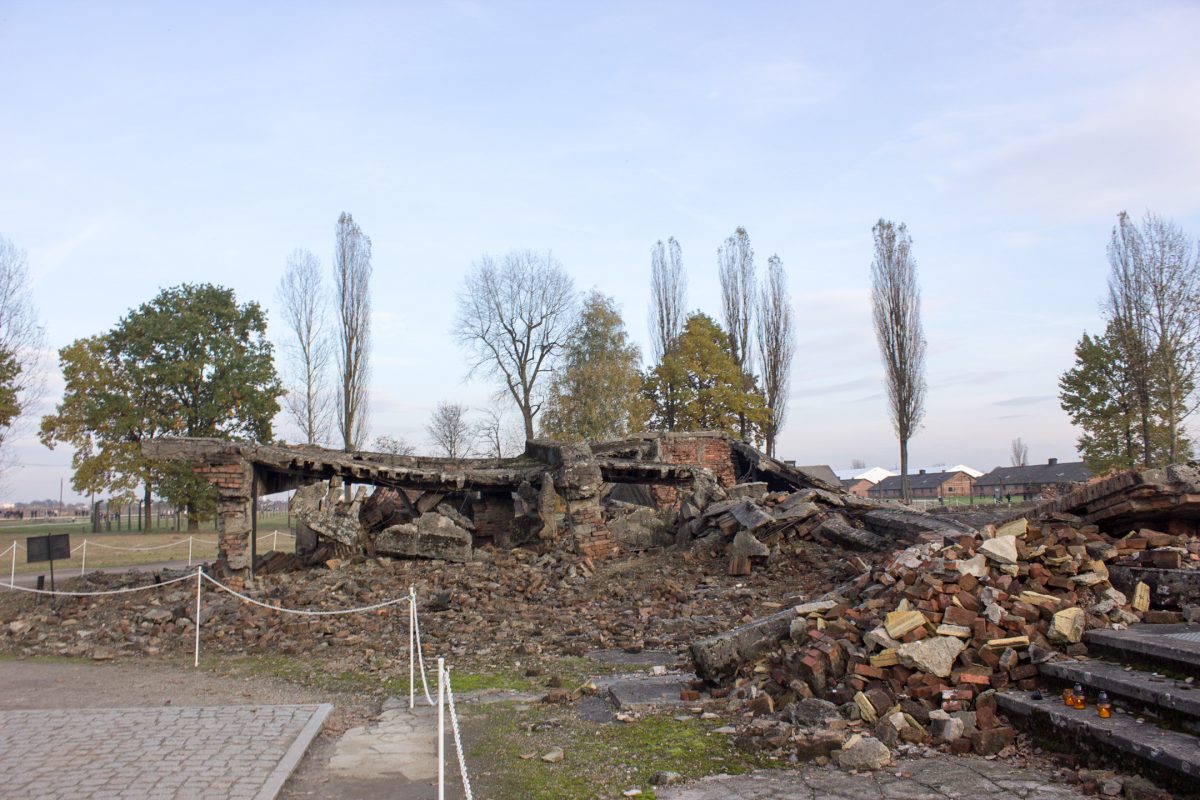
"Auschwitz," or, "I'm not putting a silly title on this."

One death is a tragedy. One million deaths is a statistic.

The human mind is a miraculous thing, but it’s also a flawed thing. We weigh emotions far more highly than we do logic, which is how something like the quote above1 comes into being. To the human mind, a single death is a tragedy – a life snuffed out, an intelligent being gone from the world. A million deaths, though? We can’t comprehend that in the same way; instead of a million tragedies, a million lives gone unlived, untold billions of hopes and dreams obliterated, it’s just… a number.

In the years 1940-1945, the Nazis deported at least 1,300,000 people to Auschwitz:
1,100,000 Jews
140,000-150,000 Poles,
23,000 Roma (Gypsies),
15,000 Soviet prisoners of war,
25,000 prisoners from other ethnic groups.
1,100,000 of these people died in Auschwitz. Approximately 90% of the victims were Jews.

On Monday afternoon, we arrived at Oświęcim, a town of about 40,000 people about an hour away from Krakow. As towns go, it’s fairly normal – the most notable thing I can remember seeing was a mall that was utilizing a KFC as an anchor store.
And then you hit the edge of town, and find out why the name seems ever so slightly familiar: three quarters of a century ago, the Nazi government of Germany decided they needed somewhere to put their prisoners. Having recently conquered Poland, they decided they wouldn’t waste any of their precious homeland on prisoners, and allocated some land in their new largesse. With a characteristic disdain for everyone they were in control of, they wrote off the Polish language – and all the Polish names for places – and renamed the town.

Categories
Review

"Boundary Crossed," or, "logically speaking that should *either* kill him… or give him immortality. huh."

I do enjoy the writing in this book – I was working on a different one, but it had such clunky phrasing going on throughout that I put it down and started working on this one instead. And I’m happy I did that – it was definitely better-written, and I enjoyed it quite a bit more.
That said, there’s something about the whole “magic exists but it’s a secret” thing that I’m getting very bored of, at the moment. It just feels like, in the Information Age, keeping something that big a secret would be impossible. Nevermind the whole “cover everything up, we’re all in on the conspiracy” thing, but just the idea that you’d be able to keep every bored teenage vampire or whatever from posting selfies of themselves doing something vampiric, or that nobody would ever make a mistake? That’s what pushes the limit of my suspension of disbelief – not the whole “surviving being killed” or “throwing people around with your mind” thing. I dunno, I’ve just got weird priorities when it comes to realism in fantasy.
But once I got past that, I really did enjoy the book – there’s a lot of cool stuff going on with the way magic works in the book, and even more fun than that was the sort of politics being displayed.1 There were a few bits of the plot that I totally wasn’t expecting, and one that I was but was still annoyed by when it happened, but oh well, you win some and you lose some. The main character is an interesting one, and I do think I’ll keep an eye out for the sequel – once I’ve finished the other books on my “to read” list, of course.
tl;dr: I’m not in the mood for this book, really, but I did like it anyways, so give it a go.


  1. Werewolf pack stuff was briefly mentioned, but irrelevant to the story, and I’m kinda hoping that the sequel goes more into that. ↩
Categories
Review

Strictly Analog

I had a big burst of reading the other day and powered through most of this book in one sitting. Sometimes I just need a break from all the German, y’know?
Anyhow, the next book on my reading list was Strictly Analog.1 Reading this one was a bit interesting, because I was caught by the initial setup – the setting is just futuristic enough that I can see exactly how it’d come to be in the real world – but then sorta dropped off for a while. I think that was mostly due to the actual background of the story – it’s set in a version of California that’s controlled by a corporate government2 and, a few years back, declared independence from a crumbling United States. The main character lost an eye in the year of war that ensued, fighting as a troop for California in a bid to annex Las Vegas.3 Basically, it’s a bit more ‘post-apocalyptic’ than I tend to like. That’s kinda how it wound up being cut off my “to-read” list; I wound up putting it back on there by accident, since I picked up my Kindle for the first time in a few weeks and just started reading whatever was already open from last time. Surprise second chance for the book, which worked out pretty well. Back into the story:
The loss of his eye renders him incapable of using Iyz,4 the smartglass-type tech that’s gone as ubiquitous as smartphones are today. Thus the title: he’s “strictly analog” in his work, providing a non-traceable private investigation service for his clientele. I did enjoy the touch about why this is necessary – the CalCore network, containing a massive amount of data on every citizen, is searchable for a small fee. But, once you search for someone, the fact that you’ve done that is made public, and they’ll be notified. So if you’re, say, trying to find out if your spouse is cheating on you? You’d want to be a bit more discreet about that.
Where the story picks up, though, is when Lomax’s5 daughter shows up. Her boyfriend had been acting weird, and her mom is a rather useless character, a riff on the “Beverly Hills” type.
The next morning, things go to hell. The boyfriend was found dead, and Lomax’s daughter was arrested for doing it while he was out working a6 case. Problem: she didn’t do it.
And then things get fun – turns out she met the guy because he works with her stepdad, a higher up in CalCore’s secret police. Instead of a normal trial schedule, she’s due to be arraigned and sent to trial within five days. Someone up high wants the mess cleaned up.
From there, it’s a fun romp. I love some of the other characters who show up later, and despite the rough start I can happily say that I recommend this to anyone who likes a good murder mystery. Have a read.


  1. Actually, looking at my reading list, I’d marked this one as cancelled, something I’ll address later. ↩
  2. Referred to as “CalCore” throughout, it’s short for “California Corporation;” within the story, that happened when an energy company formed CalCore as a subsidiary that, using the awful Citizens United ruling, said the company had the right to run for Governor. And then it won. ↩
  3. They did apparently win that war; I’m sure Nevada wasn’t happy about it. ↩
  4. I think I’m spelling that right, but I don’t actually care enough to check. ↩
  5. The main character, Ted Lomax, whose name I’ve somehow avoided using until now. ↩
  6. generic “yes, your husband is cheating on you” ↩
Categories
Review

The Red Plague Affair

The last Saintcrow book I read I definitely enjoyed, and this one was no different. Definitely more frightening, though, because while the Iron Wyrm included some nice spooky stuff, there’s something about a pathogen that just scares the crap out of me. Probably the relative likelihoods of “death by giant dragon” and “death by disease.”
Anyhow, as with the previous book, the setting is still a gorgeous alternate-history Victorian London. There’s a bit more expansion on how some of the magical stuff works, and some delightfully irritating open-ended bits about some of the history of how these things were created.1
(To be honest, I’m keeping this review rather short because it’s the second book in the series – I linked to my review of the first one as a way to get you to go read that one and then read the first book before you’d read the second.)
There was rather more of a hat-tip to Sherlock Holmes than even in the first – Clare, our Sherlock figure, was given his own Moriarty in Dr. Vance. A seriously fun interaction.
And Bannon, our delightfully immoral sorceress, found herself even more embroiled in politics than before, creating some interesting situations. I’m looking forward to the next book in the series, though it’ll probably be a while before I get to it – my ‘to read’ list is still rather long.
That said, I quite enjoyed the book. If you haven’t read the first, go do that. Once you’ve read the first, read the second as well.


  1. Apparently the levitating Collegia, home of the sorcerous school, was once the top of a mountain, but then someone decided “nah, we want this somewhere else” and just ripped the top off the mountain? so cool ↩
Categories
Articles

Peace Day

Assuming I’ve got this written in time, today as September 21st. It’s my birthday!1 It’s also the International Day of Peace. The United Nations General Assembly, in 1982, declared that September 21st would be dedicated to world peace.
So this year, on World Peace Day, I’m hoping we can take some time to talk about nuclear weapons. They’re something I’ve written about a few times before, because they’re fascinating. It’s a weapon with a higher explosive yield than anything else we’ve ever made,2 and it’s also got some nasty aftereffects – the amount of time it takes radiation to subside to background levels after an explosion can be measured in anything up to tens of thousands of years.
Personally, I refer to nuclear bombs as “hell weapons.” Especially within the context of the Cold War, their use would be like making a deal with the devil – sure, your enemies get pretty messed up, but you know that you’re gonna get screwed over just as hard when it comes time to pay the bill.
So, whenever I see people saying they’d consider their use , I am horrified. I wasn’t even alive during the Cold War, and I still spend a lot of time thinking about the specter of instant annihilation that everyone on the planet was under during that entire time.
Normally I’m against fear as a motivating tactic, but I just don’t think people are afraid of nuclear weapons as much as they should be. The US stopped nuclear tests when the Comprehensive Nuclear Test Ban Treaty went into effect.3 The Soviet Union collapsed. Under President Obama, the idea of the US utilizing a nuclear weapon has seemed utterly ridiculous – basically, nobody that’s not directly neighboring North Korea really thought nuclear annihilation was a real possibility. Basically, once the Doomsday Clock folks stopped telling us to be utterly terrified, we let that fear fade into the background, and it’s just about gone now.
But I’ll say it again: nuclear weapons are hell weapons. Don’t take my word for it, though: as I’ve mentioned, I spent last Friday in the UN’s Vienna headquarters, listening to WWII survivors. One, Yamada Reiko,4 gave a speech titled “My Experience of the Atomic Bombing and Message of the Hibakusha.” I’ve got a few quotes that I’m going to share with you.5 (Emphases mine.)

Our town was 2.5 kilometers from ground zero and escaped from raging fires caused by the bomb. Many injured and burned people fled to this area from the city center. They were so heavily burned and disfigured that they did not look like human beings.

The bomb dropped on Hiroshima had a yield of 67 terajoules equivalent to 16 kilotons of dynamite. The design was considered “very inefficient” – less than 2% of the present nuclear material underwent fission. The largest weapon still present in the US nuclear arsenal is the B83,6 with a maximum yield of 1.9 megatons – more than 100 times as powerful as the bomb that obliterated everything within one mile of the detonation and set fire to everything within five.

On the second day after the bombing, a moving black lump crawled into [my friend’s] house; they first thought it was big black dog, but soon realized it was their mother. She collapsed and died when she finally got home, leaving her 5 children behind.

Roughly a third of the population of Hiroshima was killed by the bomb – somewhere around 75,000 people. 

Nuclear weapons are absolutely inhuman weapons. Even a single bomb can turn a whole city to ruins in an instant, kill people indiscriminately, and deprive even future generations of their lives. We the Hibakusha call them “weapons of the devil.”

I’m hoping I’ve made my point fairly thoroughly: nuclear weapons are a bad business. Their use as weapons is deeply horrifying, and even ‘peaceful’ uses have considerable problems. Nuclear tests have spread radiation around the planet and rendered large swathes of land uninhabitable; Soviet ‘peaceful detonation’ programs had similar effects.
And here’s where it gets weird: the closest we’ve got to a ban on their use is a treaty that says we won’t make more than a certain amount. The Comprehensive Nuclear Test Ban Treaty is a good start, but the US, still hasn’t ratified it, despite being the single biggest guilty party still in existence. Similarly, the largest non-proliferation treaty is still lacking key signatories.
Clearly, we’ve still got some issues with nuclear weapons. Now, the call to action: make it clear to the folks you’re voting for, regardless of who they are, that the use of nuclear weapons is not in the cards. Join the International Campaign Against Nuclear Weapons.
Happy Day of Peace, everyone. Make it count.


  1. I’m turning 21 while in a country with a drinking age of 16, a fact I find quite amusing. ↩
  2. Well, technically antimatter has a higher energy yield per gram, but we’ve never manufactured enough antimatter to actually weaponize it and I pray that we never find a reason to do so. ↩
  3. Actually, we may have stopped with the Partial Nuclear Test Ban Treaty, but I’m not entirely sure and it’s not actually super important to what I’m saying here, so I digress. ↩
  4. Vice Chairperson of the Tokyo Federation of A-bomb Sufferer’s Organizations (TOYUKAI) – she’s an impressive lady. ↩
  5. These are translated – the speech she gave was in Japanese, and as event staff I had access to the transcript used as a cheat-sheet for the folks doing live translation. ↩
  6. Taking over after the B53, a 9 megaton weapon was retired. ↩
Categories
Education Travel

“Neural Audio,” or, “What I Did This Summer”

I’ve had a few people1 ask me what, exactly, I was doing all summer, off in Louisiana. As a programmer, being efficient is sort of the goal of everything I do; as such, doing a single write-up here and then sending that link to people makes more sense than answer the question over and over.2
I spent the summer working at a National Science Foundation-funded Research Experience for Undergraduates at the Center for Computation and Technology at Louisiana State University.3 It’s a pretty cool setup they’ve got at the CCT4 – it’s not an academic unit, it’s a research group only. The building has all sorts of handy resources – all of us in the program had access to both a shared workspace for the REU students and our own individual workrooms, which varied depending on our project.5 The exciting new thing for me was the server room, which I had access to.6 There were a few machines of interest in there – HIVE, a cluster-in-progress that was devoted entirely towards art that required high-powered computation, and Titan, a machine designed for use with neural networks.
This is where I lead in to my specific research program, which wound up being titled “Neural Audio,” as above.7 The goal was basically an exploration of the use of deep neural networks for music information retrieval.
Whoops, went a bit jargon-heavy. Let’s break it down.

Deep Neural Networks

You may have heard about this one before – neural networks are the current big thing in artificial intelligence. Google uses them to power a lot of things, but the big one people have heard about is Google Photos, where deep neural networks provide the incredible search features.8 As you might guess from the name, they’re based off the structure of the human brain:9 a bunch of nodes, connected by weighted edges, which are the neurons and synapses of the artificial brain.10 Now, what’s cool about machine learning is the training: instead of sitting down and writing an algorithm to perform a task, you just build up a big data set of questions and their paired answers. Then you feed it into the system, and it learns11 how to answer the questions.
Of course, it’s not that open-ended- you can’t drop the works of Shakespeare in there and expect it to write a paper analyzing his writing style.12 They work best with categorization – you give them a set number of categories, and the network can tell you either which category something belongs to, or the percentage chance that thing falls into each category.13
Beyond that, there’s nothing fancy about neural networks – they’re just a software construct used to do a heck of a lot of math, the end result of which is an algorithm that no human could’ve designed. Cool stuff.

Music Information Retrieval

The field of MIR isn’t new, they’ve been around for a while doing cool things. It really does what it says on the tin: the idea is to be able to feed a piece of music into the software and receive useful information about the music out. Software that can recognize the key of a song being played or identify the speed at which the piece is being performed are good examples of this.14

Combining Them

My work was basically looking into combining these two fields. Machine learning can do some cool stuff, the idea went, so why not try applying it to music?
This took two forms: trying to identify the genre of a piece, and trying to identify the instruments playing in a piece.
It’s here that I’m going to hand off the explanation to another thing I was working on this summer, though as a test subject rather than a researcher: the digital poster. One of the other research groups at the CCT was working on a system to modernize the poster presentation, a staple of scientific conferences. I had the opportunity to be one of the trial-run students for the digital poster, and wound up putting together an online version as my way of wireframing what the final product would look like. Being me, I made my wireframe look just as good as the ‘official’ one, and wound up posting the whole thing online and providing a QR code on the paper poster15 that linked to the online site.

Wrap-Up

While the summer, and thus the time I had at LSU, came to an end, the work didn’t. I’m still16 trading emails with my mentor, and I’m hopefully going to be attending another conference at some point to talk about my work. In the interim, I hope to be able to get some additional work done, maybe get some more interesting data out of the machines. It’s a goal, and time will tell how well I’m able to accomplish it.
That’s about all I’m going to write here – if you want to know more, you can check out the digital poster, and if that doesn’t get you enough information, you can fire me an email, it’s grey (at) this site.17


  1. Reasonably ↩
  2. If I were teaching a computer science course, the first thing I’d say would be along the lines of “‘efficiency’ is just a codeword for ‘laziness that won’t get you fired.’” ↩
  3. Or “LSU CCT NSF REU” for out-of-order short. ↩
  4. I hope you read the last footnote, because I’m going to be using these short-forms of the names throughout. Efficiency! ↩
  5. One person had a few offices shared with graduate students working on the same program; another had a Mac lab to themselves; I was given the key to a media lab on another floor. ↩
  6. I found this oddly entertaining after I had to let one of the IT staff in there to reboot a server following a power failure. ↩
  7. I kept trying to make it “neural audio,” because I’m a millenial and thus hate capital letters, but I was overruled by my mentor. Probably for the best. ↩
  8. Seriously, the fact that I can search for someone’s name and have it accurately spit out a list of every photo I’ve taken with them in it is seriously impressive. The fact that I can ask for stuff like “mountain” or “car” and also get accurate results? Mind-blowing. ↩
  9. Though, it’s important to note that they’re not based off an accurate/current idea of how the human brain works; we’re computer scientists, not biologists. ↩
  10. The weighting of the edges is important, as that’s where all the magic happens. Each node, simplified down, is performing an averaging operation over all of its inputs. The output is then passed along the edges, and transformed by the weight of that edge, creating the new input for the next node. ↩
  11. Using a system called Stochastic Gradient Descent, which I find to be a very elegant solution the problem. (I recommend reading the previous footnote before this one.) Learning, via training goes like this: you feed the network an input, and the randomized initial weights do the processing and spit out an answer. That’s probably not the right answer, so the network will change the weights in a random ‘direction,’ and then try again. If it’s closer to the right answer, the network will change the weights in that direction again; if it was further away, it’ll try a different direction. The process of training is just repeating that operation over and over and over again. ↩
  12. Although, entertainingly, you can drop the entire works of Shakespeare into a neural network and have it make a spirited attempt at creating a new work in the style of Shakespeare. ↩
  13. That’s called softmax, and it’s pretty handy. I looked at using changing softmax results over time as a way of extracting metadata from music. ↩
  14. Entertainingly, some of the best examples of MIR arguably aren’t MIR at all: Gracenote, for example, the system that allows the ‘smart’ stereo systems in cars to figure out what CD you’ve just put in, is based on a ‘CD fingerprint’ that looks at the length of the tracks and when each one starts. It is possible, with a lot of effort, to design a CD that will show up as being something entirely different than it actually is. ↩
  15. We were all required to make traditional paper posters, regardless of our use of digital posters. ↩
  16. Infrequently, because time zones. ↩
  17. I’m not dumb enough to put my email address up on the open web, c’mon. I already get way too much spam email. ↩
Categories
Review

The Long Cosmos

Normally I let the spoiler warnings for these be implicit, but this is the fifth (and final) book in a series, so I’ll go ahead and put it here again, to be clear: spoiler warning.
Good? Good.
So, I was a little bit sad to find that, as I’m writing this, I only have a single post tagged ‘Terry Pratchett’ on here. Which makes sense, I suppose – my love of his writing predates my writing book reviews. A bit of a shame, really, because that would be more than 60 reviews – he was a rather prodigious writer.
Now, I mentioned in my previous Pratchett review that it was his last book. That wasn’t entirely accurate – it was his last Discworld book, but the Long Earth series hadn’t wrapped up yet, either. And for this, he had a coauthor – Stephen Baxter.1 I’m going to drop in a chunk of the foreword, written by Baxter, here:

The books have been published annually, but we worked faster than that; time was not on our side, and Terry had other projects he wanted to pursue. Volumes 1 and 2 of the series were published in 2012 and 2013 respectively. But by August 2013 we had presented our publishers with drafts of the final three volumes of the series, including the present book. We did continue to work on the books subsequently. The last time I saw Terry was in the autumn of 2014, when we worked on, among other things, the ‘big trees’ passages of The Long Cosmos (chapter 39 onwards). It has been my duty to see this book through its editorial and publishing stages.

Having just finished reading the book, I know now what the ‘big trees’ passages he references are, and it makes me happy in a quiet, sad way to know that Pratchett had his hands on those directly. My first experience with Terry Pratchett was the Nomes trilogy.2 I’ve no idea where I got them – it was long enough ago that that memory is entirely gone – but I know that it captured my imagination in a wonderful way. The books were silly and sweet, and the characters even more so. But they didn’t quite capture my interest the way the Discworld books would later. I do distinctly remember how I found my way into that series – the Kindle had just come out, and I really wanted one. While we were on vacation, a family friend who had one offered to let me play around with it to see what I thought.
I’ll interrupt this story to reference the fact that I tend to be reading a lot of books at once – one or two paperbacks, something on my Kindle, and something else in the Kindle app on my phone.3 On this vacation, I hadn’t brought the paperback I was reading, but I remembered the title – Dark Watch. Except I didn’t quite remember the title, and put in Night Watch instead. I’m sure the Kindle Store tried to show me the cover, but low-resolution grayscale images aren’t super helpful, so I wound up downloading the sample of the wrong book.
But hey, never look a gift horse in the mouth – I figured I’d read the sample, it’d work just as well for figuring out if I liked the Kindle or not.
And I did – I’ve mentioned before that the original Kindle was, in my opinion, the Best Kindle, and the fact that when it (sadly) died, I replaced it immediately. When I got mine, the first book I downloaded4 was Night Watch. I finished reading it, and I’ve loved Terry Pratchett ever since then.5
Finding out that he was working on a science fiction series? I was intrigued. I’ve read The Dark Side of the Sun and Strata6 They were both characteristically hilarious, but more importantly, interesting takes on the genre.
The Long Earth series is quite a bit more serious than those, but it’s nothing the less for it. It’s also lacking in those characteristic footnotes, which makes it feel less like a Pratchett work than any of his other stuff, but it’s still deeply fascinating. The world building throughout is marvelous, and the degree to which they extend it is, I think, my favorite thing about the series.
It basically starts off with a single premise: stepping. A device is invented, the blueprints published online for all to see, that allows the user to step, moving from one Earth to another in an apparently-infinite chain of Earths. Only ours, referred to as the Datum Earth, has a human population: the rest are pristine, untouched natural wilds. From there, it’s extended: each of these Earths is something akin to a quantum probability mesh, and the further out from the Datum you go, the stranger things can get. One step away, the only difference is that there’s no industrialization-aftereffects from humanity. Go ten million steps away, and you hit worlds where life as we know it never evolved, and instead there are slime colonies the size of small buildings wandering around. Ten million steps in the other direction, and you can climb a tree five miles high and fight giant lizards in the forest of its canopy.
Of course, this does Bad Things to the governments of the world – who’s going to stick around and work a 9-to-5 when they can hop over a couple worlds and have a hunter-gatherer lifestyle? Who’s going to pay taxes if they live on a homestead ten thousand steps West7 that doesn’t see a dime of government services?
And Pratchett and Baxter play with that – as the series goes on, and by the end it’s spanned nearly 400 years of history,8 you can see the way the United States reacts to the paradigm shift that is stepping. It’s fascinating.
And then you get to Book Three, and explore the Long Mars. Because somewhere along the infinite chain of Earths, there’s one where the asteroid impact that formed the moon hit at a different angle and the Earth never formed. Which is a terrifying way to die – you think you’re going to step normally into another world, but instead find yourself suddenly in interplanetary space. But people are creative, and it’s possible to bring materials with you, so the Long Earth’s equivalent to SpaceX forms up on the world just this side of what becomes known as the Gap. Forget about expensive rockets – just hold onto your spacecraft, and then step right out of the gravity well. Once you’re free-floating, step back, and you’re suddenly in orbit, at about a billionth the energy cost. Space exploration is suddenly a lot easier.
And then a bonus twist on the concept: Mars is Long too, but in a different direction. Sure, it’s still stepping East and West, but a step West from Mars gets you to a different reality than a step West from Earth.
Book four is where things get spooky. (Spoiler warning again, because what I’m talking about now is from closer to the end of that book, rather than early-on reveals as above.)
Given a multiply-infinite series of worlds, certain things become inevitable. Von Neumann machines are one of these – somewhere out there along that infinity, there’s going to be a sentient lifeform. Given that it’s truly infinite, there’s probably going to be an infinite number of those. And at least one of them will have been smart enough to come up with the idea of a von Neumann probe, and dumb enough to actually build it. And then the problem with von Neumann probes shows up, one that we here on our Earth have been dealing with for centuries: self-replicating systems will eventually have a problem. For humans, with our self-replicating cells, we call it cancer. A von Neumann probe system will similarly eventually become cancerous, which makes it a massive threat to the entire galaxy.
And that’s all I’m going to say about The Long Utopia. I’m 1,500 words in, I should probably start talking about the book in the title.
The Long Cosmos takes another spin on that “given an infinite universe, there will be sentient life” thing. With the von Neumann probes, we never actually saw their creators, nor even any evidence that they’re still alive. In The Long Cosmos, though, we get proof of life: a signal that blows SETI’s “Wow!” signal out of the water.
“Join us.”
And that’s all I’m going to say about the story, I think. Suffice it to say it’s in the same vein of the rest of the Long Earth books – a delightful look at a truly large-scale world, and the people who inhabit it. It’s those characters who really make the story, and it’s a nice way to check in with all of them again.
Overall, it’s a wonderful book. Each one gets larger in scale than the last, and that’s what I like about them – it’s such a huge world to play around in, and the underlying concept is simple and understandable. It’s a veritable playground for the imagination.
As with every single other Terry Pratchett book out there, I highly recommend it. Start with the first, of course, but when you’ve read the rest of the series, read this one too.


  1. There’s nothing tagged under his name, as of yet, but I figure I’ll link to it anyways. Might read more of his work in the future, you never know! ↩
  2. I’ve actually still not read the first one in the series, but once I’m home and have access to my library I might go back and reread the second and third. ↩
  3. And yes, Amazon’s WhisperSync service does function to keep me in one place in the book if I read it on both devices, but I like this way better. ↩
  4. Aside from a bunch of free stuff from Project Gutenberg ↩
  5. And been heavily influenced in how I write – I like to say my use of footnotes has a lot to do with David Foster Wallace, and there’s some of him in there, but it’s a lot closer in style to Sir Terry Pratchett’s. ↩
  6. And I want to get a copy of Strata for myself, but it’s still hard to get in the United States. Ooh, maybe I’ll find a used book store while I’m abroad… ↩
  7. As opposed to East – knowing which is which is apparently an instinctive sort of thing for people when they step. ↩
  8. From the actual start point to the end point, it’s closer to 80 years, but there’s a good bit of prequel-type action in the earlier books. ↩
Categories
Review

A Short History of Nuclear Folly

So, ever since I heard about this book, I’ve wanted to read it. I’m a sucker for all this Cold War history stuff, okay? This isn’t the first time I’ve written about the books I’ve read on the subject.1
Anyhow, I’ve reached a point where very little of what I read in this book was actually new to me. Which is weird, because I hardly feel like an expert on the subject, but apparently I’m getting close. How strange.
That doesn’t mean that I didn’t like it, or that I didn’t get anything new – quite the contrary, there were a couple really interesting bits in there that I found fascinating, and some things that I’d either never heard of or never explored in depth.
For example, while I knew about Project Plowshare, I hadn’t looked into some of the frankly ridiculous things they were trying to do.

Plowshare kicked off with the relatively small “Gnome” test near Carlsbad, New Mexico, on December 10, 1961. It was aimed, among other things, at investigating whether a nuclear explosion could be harnessed to produce energy. But the detonation destroyed the machinery that was supposed to convert the blast into power.

Hold up. They were trying to use a nuclear bomb as a generator? Had… had nobody told them about nuclear reactors? We already had those, folks.
But no, it’s more ridiculous than that, because if you dig into the full reports from the Gnome and Sedan tests, you find this:

GNOME was developed with the idea that a nuclear detonation in a salt deposit would create a large volume of hot melted salt from which heat might be extracted. The possibilities to be investigated for the production of power were the tapping of the steam created by the detonation itself and the generation of high-density, high-pressure steam by the circulation of some heat-absorbing fluid, like water, over the heated salt.
Defense Nuclear Agency, Projects Gnome and Sedan: The Plowshare Program, (Washington D.C.: Defense Nuclear Agency, 1983): 38.

tl;dr: they were going to build a geothermal power plant somewhere with no geothermal activity, and then set off a nuke to create the underground heat.
Gotta love the cold war. Other idiotic things that Plowshare wanted to try, but fortunately, was stopped from doing:

using nuclear bombs to melt the ice from polar ports, to re-channel rivers or to desalinate salt water from the ocean.

That said, the Soviets did even dumber stuff, including my single favorite sentence from the whole book:

Between 1965 and 1989, [the Soviets] carried out 116 civilian explosions . . . five were used to combat fires at oil fields.

“Hey boss, we’ve got a bit of a fire going over here.”
“Alright, we’re just gonna nuke it.”
“Seems reasonable.”

I’m going to stop here, because I can’t give away all of the fun parts of the book.2 I quite enjoyed it, so I’m quite happy to recommend it. Have a read.


  1. Fun story: Chase is trying to convince me to write a book about this stuff, because he’s a history nerd and thinks other people should be too. ↩
  2. And the long-winded blog post on the subject that I might wind up writing in the future, if Chase gets his way. ↩
Categories
Review

Colt Coltrane and the Lotus Killer

I’d forgotten how much fun detective novels can be. Who doesn’t like trying to figure out a mystery? It’s a good bit of intellectual fun. And there’s something unique about being the reader – not only do you know what the detective knows, you also know what scenes are important and which ones weren’t. You know the difference between Checkov’s gun and… a regular gun.
Colt Coltrane takes place in an alternate-history setting, with the divergence having taken place sometime during WWII. There’s a brief mention of the fact that the U.S. never actually dropped an atom bomb, despite having the capability, and the Takahashi corporation, formed by someone who managed to escape from Japan to get back to the States, manufactures semi-sentient robots for police and military use. The aesthetic of the book falls somewhere between film noir and Lost in Space. It’s very interesting.
I’m definitely interested in the sequel that apparently exists, because I want to know what’s going on with Petey, and I think there’s plenty of room for expansion on some of the different things that appeared in this. Plus, with some of the stuff that happened with the background characters, it feels almost like the pilot to a TV show – kinda like Odd Thomas, actually.1
So yeah, that’s about all I’ve got to say. A gorgeous alternate-history setting, some fun robotics, and an interesting mystery at the heart of it. I recommend it. Go have a read.


  1. That’s not the best comparison, as Odd Thomas was a solo movie, but it was based on the first book in a series and it really felt like it could’ve made a nice spin-off TV show. ↩
Categories
Review

All These Shiny Worlds

So, if you haven’t heard of StoryBundle, it’s definitely something you should check out. It’s a Humble Bundle type of thing, but focused on indie books, rather than games.
I honestly can’t remember how I came across it the first time, but I do remember buying the first Immerse or Die bundle, and quite enjoying it. Now, I’m subscribed to StoryBundle’s email list, and I’m starting on All These Shiny Worlds, an anthology put together based on the concept of Immerse or Die.1
As with the way I usually do anthology reviews, I’m going to give a short response to each story. I’m doing something new, this time, though, and being a more responsible reader – each short story, in this review, has the author’s name listed. Where applicable, their name is a link to reviews of other books/stories of theirs that I’ve reviewed.2

The First Man in the World

Misha Burnett
An interesting take on the idea of a generation ship – rather than an AI steward, have an actual human doing it, cloning them a new body when the old one breaks down. I’m not entirely sure if I like that idea, to be honest – sure, AI is tough, but I think the whole thing could’ve been managed with a good set of algorithms that know to wake up a human caretaker from cryo-sleep or whatever if something it’s not programmed to deal with happens.

Three Demon Gambit

J.S. Morin
Oh, this was fun. Everyone with sense knows you shouldn’t make deals with the devil, or demons in general – they’ve had millennia to become experts in all sorts of tricky little contractual loopholes. But summoning three demons and playing them against one another? Oh, that’s delightful.

Rolling the Bones

Richard Levesque
Eurgh, the editor’s note at the beginning was right about this one. Not all that dark, but creepy. That poor girl.
And it ended on the worst wordplay I’ve ever read. Bonus points for that.

All the Way

Graham Storrs
Reminds me of nothing so much as the teleportation problem – continuity of self across iterations. As a counterpoint to the arguments someone was making in this, I’ve got a relevant SMBC comic. Either way, it was a sad little story about transhumanism, I suppose? One of those post-singularity ideals, at least.

Scales Fall

Dave Higgins
This one was darker, and weirder – Egyptian magic, rather than what we see all too much of in most fantasy, and a lot of the different beliefs present in ancient Egyptian religion. I honestly don’t know how I feel about the ending – I can’t quite say if it’s a happy or sad ending.

The Ant Tower

Christopher Ruz
Oh, this one was almost something I’d like. Almost, but not quite, because of course it had to go all dark. Bah, and humbug. Nice character building, at least.

Heft

Brett Adams
Back to the fun sort of thing – a rather iffy description of CIA operations, with that characteristic disregard for the illegality of CIA operations on US soil, and then breaking into the church of Scientology of all places. What a nice little adventure, and the twist ending? Delightful. Plus, one hell of a hook on this, as it opens with

The sex snail.
Meetings with Walt always ended with the sex snail.

The First Acolyte of the Upshan Berental

Bryce Anderson

She’d once overheard a priest call it “The Sacred Thingy,” which had seemed blasphemous but also accurate.

Go click on that link on Bryce’s name, because he’s a wonderful writer and I’ve loved everything I’ve read that he wrote. This was no different – a funny little story, set in a valley cut off from the rest of the world and guarded by… The Sacred Thingy. And I must say, I don’t disagree with the final decision the protagonist made – in her place, I’d have done the same thing.

Bronwen’s Dowry

Belinda Mellor
It was sweet! The competition scenes had me a little bit nervous – I’m still not entirely sure on what happened with the person who got first, what their actual prize is, but it worked out well for everyone, I suppose.

The Spider and the Darkness

Russ Linton
I think the setting this one starts in would definitely qualify it as ‘dark fantasy,’ but it does eventually get out of there. It kinda reminds me of some of the scenes in Battle Magic, Tamora Pierce’s most recent book. Secrets of the earth, and all that.

The Dowager’s Largesse

Jefferson Smith
This… might be my favorite one of the whole book, thus far. I love the setting it’s in, and I want to read more of it. I love the idea of an old Empire with old magics written into the land, somewhat forgotten or ignored by the current government. I love that the Dowager Empress put together this whole complex system of free booze and magic3 as a way of searching for something, and I love the way she checks to see how things have worked out. I really do hope she survives what she started.

Theriac

Becca Mills
There’s some Buffy vibes to this one, but gone all… church-y. Which is a bit weird, and made me almost instinctively disagree with some of the things the main character thought, but it allowed for some really interesting character growth.

The Red Flame of Death

Van Allen Plexico
Again the religious fervor, but this time quite necessary – it’s the best thing for fighting demons, after all. I like the implications in there – that one day mankind will be able to utterly defeat the forces of darkness. When it comes to fighting demons, that’s not the sort of thing you usually see; usually those stories imply that it’s like fighting entropy, and one day the darkness will win.

The Blue Breeze

Regina Richards
Oh, this is a fun setting for a story. Two suns, one of which is somehow ring-shaped? That one makes me suspect it’s some sort of science fiction setup, and the ring-sun is an orbiting mirror-station or something. The protagonist lives in the Hell Hollows, which is possibly the most vicious place possible- even the trees are carnivorous.
Aside from that maybe-space-station thing going on, there’s also a Mysterious Ancient Ruin at one point, and it’s basically hitting all my buttons for a setting I’d like to read more of.

The Rakam

Karpov Kinrade
Oh, there’s a lot going on here, and I hope there’s a full novel set in this world, because I would love to see more of it. All sorts of fun macrobiology, and there’s something weird going on with the gems. A lot of fun.

And that’s it, for this anthology. I quite enjoyed it, and it’s apparently free as a Kindle book? Oh my. Go read.


  1. The point of the anthology, per the introduction, was to be a lower opportunity-cost variant of the StoryBundle; it’s easier to read a short story than an entire novel by a new author, so giving a bunch of new authors a chance is easier in short-story format. ↩
  2. I went through and put in some better tags recently, and I may as well get some use out of them. I also might go back and do this same sort of thing for my other anthology reviews, but no promises, it’d take quite a while. ↩
  3. It’s a fun mix, really. ↩
Categories
Review

Destroyer of Worlds

This was a lot shorter than I was expecting, so I’ll go ahead and warn you now – it’s short!1
I thought it was going to be some kind of science fiction thing, and there was a part of my brain making 2001 references, but that wasn’t really what it was. It was a character story. Kinda nice.
Like I said, it’s a short little story, so it’s getting a short little review. Go read it, if you’d like.


  1. My problem with the Kindle’s little ‘length indicator dot’ things is that they don’t scale well. Something like this that is, according to Amazon’s website, 29 pages, shows up as something like 8 dots, but I’ve read things that were fifty thousand words and also showed up as something like 8 dots. ↩
Categories
Review

The Thief Who Pulled on Trouble’s Braids

I don’t think this one falls under the purview of ‘dark fantasy,’ because it doesn’t end with “and then everything was awful forever, the end,” but it’s… close. Adjacent to that subgenre, I suppose.
Amra Thetys is a thief, and a pretty good one, at that – she lives in a variety of homes around the crime-ridden city of Lucernis, all of them paid for. Her friends, of course, are also thieves. So there’s nothing much out of the ordinary when one of them shows up at her door, asking her to help him hide something while he goes to sort out the payment for his services.
Unfortunately, he never comes back for it. Instead, he’s murdered pretty brutally, and Amra gets sucked up into the mess because whoever did it is after the strange golden statue she was given to hold on to. And, of course, several other people are also interested in it, because something worth killing for is something worth stealing.
Where it gets interesting, to me at least, is in the magic. Because as Amra goes on in her accidental quest to find out who killed her friend, she starts to get more and more involved in the weirdness going on – a monster with an overwhelming aura of hatred, a mage who’s far too good to be a thief but is nonetheless, a downtrodden inspector who turns out himself to be a mage.
Throw in some ancient gods, a hint of undead, a Protector-spirit that has to be locked in for fear of what it’ll do if it gets out, and a hell mouth, and you’ve got an interesting story to be told. The necromancy was a nice touch.
So, the story itself was really interesting – a sort of magical murder mystery, with an adventure mixed in by the way. No problems with that.
Where I get slightly iffy is the setting. I mentioned above that it seems a bit like a ‘dark fantasy’ kind of thing, and all of that is in the setting. The world was, insofar as I can tell from the various hints that were dropped, of the “formerly occupied by the gods” sort. There was a massive war of the gods, though, something like two thousand years ago, and it cracked open a continent or two, creating a sort of diaspora for the humans that occupied the world. And the various other races that got brief mention – there’s some kind of orc-thing wandering around that makes a hobby of murdering every human they come into contact with, I think? Not very charitable of them.1
That said, it wasn’t depressingly so – the end has some hints that, yes, the leftovers of that Age of the Gods or whatever are coming to an end, and the magic is going to go with them2 – but while it hints at that ending, it points towards the Age of Man. There’s some early precursors of the industrial era showing up – arquebusses being the main one, although the invention of mass transportation is another – so I think it’s more saying “the age of myth and legend is ending, it’s time for the age of man.”
Which is cool, I suppose. I liked it, I’ll keep an eye out for the hinted-at sequels, I suppose. Go have a read.3


  1. This footnote doesn’t have anything to do with anything, it’s just that I realized I’d gone this entire review without using one and that’s not like me. ↩
  2. Which I am quite sad about, to be fair, magic is a lot of fun. ↩
  3. And read through the little post-script bit that’s an in-character explanation of the world, because it’s hilarious. ↩
Categories
Review

The Ables

It’s a running joke, at this point, that I’m a sucker for anything with superheroes in it. It’s, like, my schtick or something.
This was an interesting one. The Ables is set in a world where superhumans exist, people with a variety of superpowers. The main character is telekinetic, a skill he inherited from his father.1 Unlike most of what I read, though, in this one the superhumans keep themselves out of the public eye. Here, they have the advantage of someone named Weatherby, a massively powerful superhuman whose ability is making people forget. All around the world, the actions of the superheroes are forgotten by the normal folk almost instantly. Which is… a really scary amount of power for any one person to have, to be honest.
Fortunately, that’s not going to be a problem for a whole lot longer – Weatherby is apparently the last in a long line of Weatherbys, all of whom have had the same power and have used it towards the same end. It’s implied that he’s rather old and has no plans to have children, so the governing body of this secretive superhero society2 are, it’s mentioned a few times, in negotiations with the governments of the world to help prepare people for the revelation that, surprise, superheroes are real.
Where it gets more off-norm for my reading is in who the main characters are. First off, they’re middle schoolers. Which… is the main reason that I almost did finish this book. The opening bits, where it’s all about being in middle school, with the tiny tweaks necessary for it to be a middle school in what is very nearly a superhero-only city? They’re a pretty good representation of what it’s like to be in middle school. Which is to say… cringe-inducing in every way. It does eventually get away from that, which is, I think, the first time I’ve been happy that a superhero book has gone away from showing how superheroes can be integrated with a modern society.3
That’s not the only bit that’s focused on in the book, though, because the other thing about the main character and his friends is how they all met: in the Special Education class. Which strikes me as a bit of a misnomer in some cases – Henry, for example, doesn’t really have any special educational needs, he’s just in a wheelchair. That said, it’s a key plot point later on that this town doesn’t consider themselves ruled by US law, and so the Americans with Disabilities Act doesn’t apply. Rather infuriating, that.
All told, it’s an interesting book, once you get into it. I don’t know if I entirely like the context it’s set in, and there’s a few things that happened that made me really mad, but I deeply enjoyed the way the plot actually went. Sure, some of the stuff that was supposed to be a big twist was astonishingly predictable, but I’m a bit more lenient about that sort of thing than I used to be.4
So, I think I’ll give this one a thumbs up. Not my favorite ‘superheroes in middle school’ novel, but then, the first place for that one is a well-developed series that’s rather hard to beat.5 Without further ado, the link.


  1. His mother is a teleporter, and his little brother is apparently going to wind up as a speedster when his powers kick in. ↩
  2. Points for alliteration ↩
  3. The “Please Don’t Tell My Parents” which I’ve reviewed… less of than I thought, actually, is a counterpoint to this. The protagonist there is also in middle school, but manages to dodge most of the cringe worthiness of middle school as a whole. As I’ve said before and will most likely be saying again, that series is a delight to read. ↩
  4. My stance on the matter is roughly “I’ve spent enough time reading that I’ve probably hit that ’10,000 hours to be an expert’ line, so a lot of stuff seems predictable to me.” ↩
  5. The fact that I can narrow my categories down this much and still have multiple contenders for first place is one of the reasons I’m comfortable assuming I’ve spent 10,000 hours reading by now. ↩